AMDS Daisy Chain
This document outlines the architecture, setup, and salient details of the AMDS’s Daisy Chain capability.
Overview
The AMDC and AMDS allow up to three AMDS boards to be daisy chained together on each of the AMDC’s GPIO ports, as shown below.
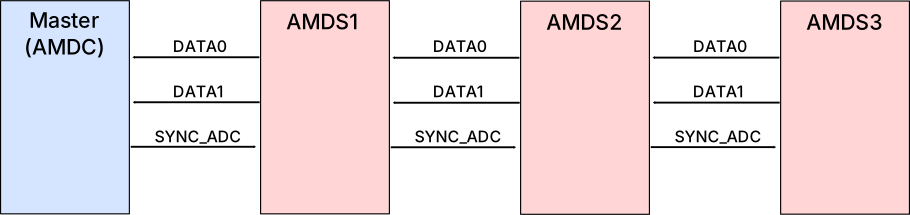
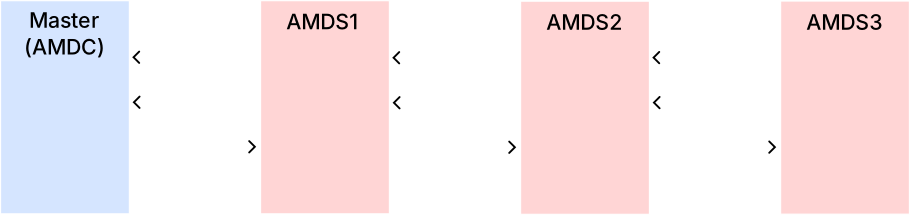
Each AMDS can run the same firmware, and does not need to know it is in a daisy chain. To each AMDS, the board “downstream” from it (i.e., the board with a lower number in the image above) appears as master.
Theory of Operation
Upon receiving a SYNC_ADC signal, the AMDS performs the following operations:
Assert
SYNC_ADCon its upstream portCollect and transmit sensor card ADC data as described in the AMDC firmware article.
Process data received on its incoming
DATA0andDATA1ports from any upstream AMDS boardsHeader packets are incremented by
0x04Data is transmitted to the corresponding downstream port; for example, if the packet arrived via the upstream
DATA0port, it will go out the downstreamDATA0port
The data will arrive on the AMDC DATA0 and DATA1 lines in the following arrangment:
AMDS |
Sensor Card |
|
Header |
AMDC |
|---|---|---|---|---|
1 |
1 |
0 |
0x90 |
1 |
2 |
0 |
0x91 |
2 |
|
3 |
0 |
0x92 |
3 |
|
4 |
0 |
0x93 |
4 |
|
5 |
1 |
0x90 |
5 |
|
6 |
1 |
0x91 |
6 |
|
7 |
1 |
0x92 |
7 |
|
8 |
1 |
0x93 |
8 |
|
2 |
1 |
0 |
0x94 |
9 |
2 |
0 |
0x95 |
10 |
|
3 |
0 |
0x96 |
11 |
|
4 |
0 |
0x97 |
12 |
|
5 |
1 |
0x94 |
13 |
|
6 |
1 |
0x95 |
14 |
|
7 |
1 |
0x96 |
15 |
|
8 |
1 |
0x97 |
16 |
|
3 |
1 |
0 |
0x98 |
17 |
2 |
0 |
0x99 |
18 |
|
3 |
0 |
0x9A |
19 |
|
4 |
0 |
0x9B |
20 |
|
5 |
1 |
0x98 |
21 |
|
6 |
1 |
0x99 |
22 |
|
7 |
1 |
0x9A |
23 |
|
8 |
1 |
0x9B |
24 |
Hardware
The cabling between each pair of boards runs at the same baudrate (20 Mbps).
Currently released AMDS hardware relies on a daisy chain adapter board placed between each pair of AMDS boards to add the necessary transceivers, as illustrated below. Details on this board can be found in the AMDS git repo’s AMDS/Accessories/DaisyChainAdapter directory.
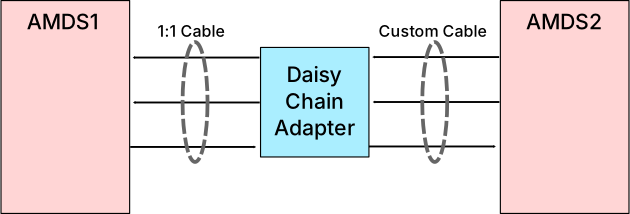
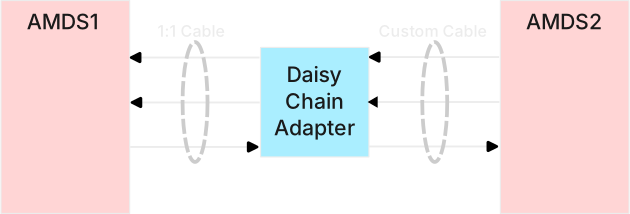
Custom cabling must be used between the daisy chain adapter board and the AMDS board to transpose the UART RX and TX pins, as listed below. This type of cable can be readily manufactured as a do-it-yourself project, or ordered from a custom cable manufacturer such as ShowMeCables. The cable should use high density, VGA-style 15 pin connectors to match the AMDS CON1A port.
DCA Pin |
DCA Name |
AMDS Pin |
AMDS Name |
|---|---|---|---|
1 |
5V_CN |
1 |
5V_CN |
2 |
UARTA_IN_P |
12 |
UARTA_OUT_P |
3 |
UARTA_IN_N |
13 |
UARTA_OUT_N |
4 |
UARTB_IN_P |
14 |
UARTB_OUT_P |
5 |
UARTB_IN_N |
15 |
UARTB_OUT_N |
6 |
NC |
6 |
NC |
7 |
NC |
7 |
SPI1_IP |
8 |
NC |
8 |
SPI1_IM |
9 |
NC |
9 |
SPI2_IP |
10 |
NC |
10 |
SPI2_IM |
11 |
GND_CN |
11 |
GND_CN |
12 |
UARTA_OUT_P |
2 |
UARTA_IN_P |
13 |
UARTA_OUT_N |
3 |
UARTA_IN_N |
14 |
UARTB_OUT_P |
4 |
UARTB_IN_P |
15 |
UARTB_OUT_N |
5 |
UARTB_IN_N |
Architecture
Direct Memory Access (DMA) for Receiving Data
To ensure near zero-CPU overhead when receiving incoming UART data, the firmware utilizes DMA streams to receive DATA0 and DATA1 data from upstream AMDS boards.
Circular Buffers: Incoming daisy-chain data is placed into
DAISY_RX1_PoolandDAISY_RX2_Pool, both of which are 256-byte circular buffers (AMDS_RX_BUF_SIZE). Utilizing a 256-byte size allows for 8-bit integer math to handle wrap-around without complex modulo logic.Error Recovery: In high-noise environments, UART hardware errors (Parity, Overrun, Noise, or Frame errors) can cause the hardware to drop the
DMAR(DMA Receiver) bit, halting the stream. The UART Interrupt Service Routines (ISRs) actively monitor for these flags, clear them, and immediately re-enable the DMA requests to ensure continuous stream operation without resetting the device.
Processing Data from Upstream AMDS Devices
Data received from upstream devices is processed immediately after transmitting all data collected from local sensor cards. This is handled by the process_routing() function. The timing of this code is carefully optimized to minimize the total transmit time to the AMDC across the enitre link.
Implementation details:
Collection of Complete Packets: The code attempts to collect complete three byte packets prior to processing. Wait timeouts are implemented.
Dual-Stream Optimization: If both UART streams have at least a full 3-byte packet ready, the logic processes them completely interleaved. This keeps both hardware TX lines saturated simultaneously.
Single-Stream Optimization: If only one UART has a 3 byte packet (i.e., a different number of packets are broadcast due to
active_sensor_mask != 0xFFon an upstream AMDS), the code follows a Single-Stream Fast Path.Fall-Back, Slow Path: If a packet gets fragmented across a DMA boundary or becomes misaligned, the system reverts to a 1-byte-at-a-time State Machine (the “Slow Path”) to recover the stream.
Thread-safe Invocation: The AMDS attempts to broadcast all DMA data within a single call to
process_routing()from theSYNC_ADCinterrupt context. However, if this times out, the firmware provides a fall-back path: the mainwhile(1)loop constantly checksdrv_uart_has_dma_data()and invokesprocess_routing()in a thread-safe manner if any further data arrives.
Performance
Daisy chain benchmark testing shows the following complete transmission times from assertion of SYNC_ADC to the last bit arriving at the AMDC:
24 sensors (3x AMDS boards, each with 8 sensor cards):
27 us6 sensors (3x 2S boards, each with 2 sensor cards):
13.7 us